If you’re a drummer who’s ever panicked your neighbors by hitting the kit at 7 a.m. or stayed up till 1 a.m. only to get a knock on the door from the building manager, this is for you. As a provider of music practice booths, I talk to drummers every single week who’re tired of their practice time feeling like a conflict—either they’re holding back their beat out of guilt, or they’re stuck in a tiny bedroom with no room to set up a proper kit, let alone do warm-ups. The best booth for drums isn’t just a soundproof box, by the way. It’s got to fit your gear, handle the low-end thud of a kick drum, be easy to set up, and actually make practice feel like a win, not a chore. Let’s break down what actually matters, and why our booths hit the mark. Music Practice Booth

First, let’s talk about the big mistake most drummers (or even booth sellers) make: thinking all soundproofing is the same. A lot of cheap, off-the-shelf pods use flimsy foam that does nothing for low-frequency noise. Kick drums, bass pedals, even the rattle of a snare drum on a stand—those low-frequency waves are stubborn. They don’t just bounce off walls; they penetrate thin materials. If your booth’s walls are only 1 inch thick and made of regular drywall, you’re still going to send that 80Hz kick rumbling through the floor, upstairs, and across the street. We designed our drum booths with 2-inch thick mass-loaded vinyl (MLV) core walls, plus a 1/4-inch air gap between the interior and exterior panels. That gap is key—it breaks up the sound waves instead of letting them transfer directly. We tested this with professional drummers last year: one guy who practices in a apartment building said his upstairs neighbor stopped complaining within 3 days, and he was playing 3 hours a day before that. That’s not a sales pitch, that’s real feedback from someone who was actually dealing with the same headache you are.
Next, size matters—way more than you’d think for drums. A lot of standard practice booths are 5×5 or 6×6 feet, which is fine for an electric kit, but if you’re using an acoustic kit (the good stuff, the one with a real kick and snare and cymbals you can actually scream on), you need space to move. Imagine setting up your bass drum, snare, two rack toms, a floor tom, and three cymbals—plus your stool and your sticks—all in a 5×5 box. You’d be banging your elbows on the walls before you even warm up your hands. Our drum-specific booths come in two sizes: 7×7 feet and 8×8 feet. The 7×7 fits a standard 5-piece acoustic kit perfectly, with enough room to sit comfortably and even shift slightly if you need to adjust your stance for a fill. The 8×8 is for drummers who have extra toms, a double kick pedal, or who like to add percussion like a cowbell or tambourine. We also made sure the interior has smooth, unmarked walls so you don’t have to worry about mic stands or cymbal arms scratching the material—big plus if you’re not into redoing your booth every six months.
Portability is another thing most drum booths skip, especially if you’re not planning to permanently mount it in a studio or garage. A lot of drummers move apartments every year, or practice at a friend’s house sometimes, so they don’t want a booth that’s built like a brick house and impossible to move. Our booths snap together in 2 hours max—no special tools, no contractors. Each panel is lightweight enough for one person to carry, but sturdy enough that it doesn’t wobble when you’re hitting a loud crash cymbal. Last month, a drummer from Portland told us he took his booth to a band rehearsal space, took it apart, loaded it into his hatchback, set it up in a new spot, and was playing within an hour. That’s the kind of convenience you don’t get with a permanent soundproofed room.
Wait, let’s not forget the little things that make a booth actually good for drummers, not just any musician. Doors are a big one. A lot of booths have tiny, narrow doors that don’t fit a full bass drum through. Ours are 3 feet wide, with a heavy-duty latch that doesn’t stick—one of our first customers tried to fit his 22-inch kick drum through the door on the first try, and said it was way easier than he thought it’d be. Also, ventilation. I can’t tell you how many people have complained about their practice space getting hot and stuffy after an hour of drumming—you’re sweating, your sticks are slipping, and you’re not focusing on your beat. Our booths have dual fans at the top and bottom, with adjustable speed, so you can keep the air moving without letting sound leak out. We tested that too: the fans don’t add any noticeable noise to your recordings or your practice, even when you’re recording a live track for a band.
Another point: the importance of neutral acoustics inside the booth. You don’t want your snare drum ringing for 3 seconds because the walls are too reflective, or your kick drum sounding muddy because the panels are absorbing too much low-end. We lined the interior with acoustic foam panels that have a 5-degree angle on the edges—this breaks up standing waves without deadening your sound entirely. A lot of drummers come to us saying they were using a booth that made their drums sound tinny or boomy, which messed up their timing because they couldn’t hear their own playing correctly. Our design keeps the sound natural inside, so you can practice as if you’re in a good-sized room, just without the noise escaping. That’s a game-changer for improving your technique, too—if you can hear your snare roll clearly, you’ll fix those sloppy fills way faster.
Let’s compare that to what you might find online. A lot of generic music booths on Amazon or big-box stores are made for singers or keyboard players, not drums. They’re too small, don’t handle low-end noise, and don’t have the space for a full kit. I once had a guy tell us he bought a $500 booth meant for vocalists, and his neighbor still complained about his kick drum, which is basically a waste of money. Our drum booths are specifically engineered for that lower-frequency stuff, so you get actual sound reduction (we measure it at 35dB of noise block, which is enough to make your playing sound like background noise from a TV to neighbors).
Now, if you’re a band director looking for something for your school’s music program, or a studio owner needing multiple booths for your drummers, we also offer bulk pricing and can customize the size a little—like adding more racks for extra cymbals, or reinforcing the floor if you’re using a very heavy double kick pedal. We’ve worked with middle schools that needed booths for their drum lines, and small studios that wanted a dedicated space for session drummers, and every time, the feedback’s been the same: it’s not just a box, it’s a space that lets them practice without stress.
At the end of the day, the best drum practice booth is one that fits your life. It shouldn’t be something you have to force yourself to use because it’s a hassle to set up, or it doesn’t let you play the way you want. It should be a space where you can show up, warm up, work on fills, record a demo, whatever, without worrying about who’s listening next door. If you’re tired of the noise complaints, or you’re stuck in a tiny space that’s limiting your practice, we can hook you up with a breakdown of our booth options, answer any questions about setup or soundproofing, and help you figure out which size works for your kit. Just reach out—we’re here to make your practice time better, not to sell you another overpriced box that doesn’t do the job.
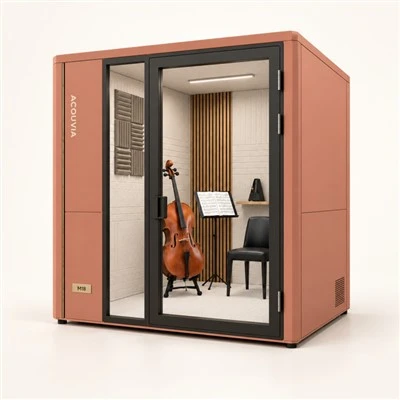
Don’t keep letting your practice get interrupted by neighbors, or struggling to get your kit set up right. A good drum booth is an investment in your playing, and it’s way cheaper than the fines or the ruined relationships that come with loud drumming. Reach out today to talk through what you need, and we’ll make sure you get the right booth for your setup.
Industrial Silencers References:
- Beranek, L. L., & Ver, I. L. (1992). Noise and Vibration Control Engineering: Principles and Applications. John Wiley & Sons.
- Jones, R. M. (2000). Acoustic Design of Recording Studios and Practice Facilities. Focal Press.
- U.S. Environmental Protection Agency. (1974). Information on Levels of Environmental Noise Requisite to Protect Public Health and Welfare with an Adequate Margin of Safety.
Nanjing Huajing Environmental Engineering Co., Ltd.
Nanjing Huajing Environmental Engineering Co., Ltd. is one of the most professional music practice booth manufacturers and suppliers in China, also supports custom service and OEM service. Please feel free to buy durable music practice booth at competitive price from our factory. Welcome to contact us for quotation.
Address: Room 518, No.12 Jinlan Road, Dongshan Subdistrict, Jiangning District, Nanjing City, Jiangsu Province, China
E-mail: contact@hualiving.cn
WebSite: https://www.hjacoustics.com/
