Alright, let’s cut through the confusion (pun totally intended) — if you’ve ever stood at a construction site, a warehouse loading dock, or a facility maintenance job, staring at two boxy, arm-like machines yelling “PICK ME,” you’ve probably wondered: scissor lift vs. articulated boom lift — which one’s actually the right call for your job? Let’s break this down like we’re chatting over a coffee break, no boring engineering jargon that makes your eyes glaze over, especially since we’re the go-to articulated boom lift crew (we swear we’re not biased… okay, maybe a little, but only because we know these things inside out). Articulated Boom Lift
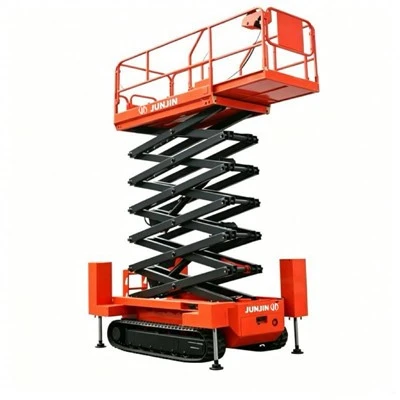
First, let’s start with the basics, no fluff. Both are aerial work platforms — they get you, your tools, and your team up high (we’re talking 20 to 180 feet, depending on the model) without making you climb a sketchy ladder. But here’s where the fun stops and the actual differences kick in: the way they move. A scissor lift? It’s basically a metal accordion. Stretches straight up, no twists, no turns, just a flat, square platform that goes vertical, stays dead-nuts level (that’s key for heavy tool belts or dropping parts), and doesn’t move side to side once it’s elevated. Articulated boom lifts? Think of them as a human arm — shoulder joint, elbow joint, wrist joint, all rotating. They can reach around obstacles, swing over walls, snake between tight spaces, even dip down and lift up like you’re reaching for a soda on the top shelf of a crowded fridge. That’s the big one, right there.
Let’s put this in real, everyday job terms, because numbers are cool, but use cases are where the rubber meets the road. Last week, we had a customer call panicking — they had to fix a broken overhead sign at a busy highway interchange. The scissor lifts they rented a year back? Way too big to fit in the space between the sign’s support poles, and they couldn’t angle the platform around the concrete barriers. We sent over a 60-foot articulated boom lift, and the operator nailed it on the first try — snaked the arm around the pole, got within an inch of the sign, no detours, no delays. That’s the articulated boom’s superpower: navigating tight, cluttered, or irregular spaces. Scissor lifts? They’re for flat, open areas where you just need straight-up height. Like a warehouse with empty floor space for changing overhead LED lights. Perfect. No need to twist and turn, just stretch up, work, and go back down.
Wait, let’s talk about platform size too, because that matters for how many people you can bring, or how much gear you can haul. Most scissor lifts have a platform that’s 6 to 8 feet long and 3 to 4 feet wide. Big enough for two people and a ladder, maybe? But if you need a cherry picker, not a box, boom lifts vary. Articulated booms have platforms that are anywhere from 3 to 6 feet wide, but here’s the thing — because they can reach around stuff, even a smaller platform on a boom can get to a spot a huge scissor lift can’t. A 50-foot scissor lift is 10 feet wide at the base, needs 10 feet of empty space to set up. A 60-foot articulated boom lift might have a 8-foot base, but since it can swing its arm over the top of things, it only needs 8 feet of space to set up — so it fits in spots a scissor lift would never squeeze into. That’s a game-changer for urban construction, right? Where every square foot of space is a commodity, and parking spots are non-negotiable for the worksite trailer.
Now, let’s get into the nitty-gritty of load capacity, because if you overload these things, you’re not just late for work — you’re risking a day that ends in a trip to the hospital. Scissor lifts usually have a load capacity between 500 and 1,500 lbs. Again, they’re straight up, so the weight is evenly distributed along the vertical axis — way more stable when you’re just lifting straight up. Articulated boom lifts? Their load capacity is a bit lower, usually 500 to 1,000 lbs. Why? Because when you’re extending the arm out at an angle, the weight is pulling to the side a little — physics, right? You can’t haul a ton of cinder blocks on a boom that’s reaching over a building. That’s not a “the machine is bad” thing — it’s just how leverage works. So if you’re moving bulk material up, scissor lift is your call. If you’re moving one person, a few tools, and a small bucket of fasteners to a spot 40 feet over a pile of pipes, boom lift is the only way.
Wait, what about terrain? Do these things work on a muddy construction site, or uneven ground? Let’s be real — job sites are never perfectly flat. Scissor lifts are mostly electric, right? And they have smaller wheels, so they work best on smooth pavement or level concrete. If you’re on a dirt site with ruts? Scissor lift might tip, or get stuck. Articulated boom lifts — we have a bunch of diesel-powered models, some with four-wheel drive, big, thick tread tires that grip like crazy. A lot of our customers use these for tree trimming, utility work, or construction on rural sites where the ground isn’t paved. They can handle sloped terrain, rough dirt, even gravel roads a scissor lift would sink into. That’s another big use case for boom lifts: outdoor, off-level, messy worksites.
Let’s not forget about maneuverability in tight indoor spaces, too. If you’re working in a warehouse with rows of shelving 30 feet high, trying to restock overstock that’s stuck between two aisles? A scissor lift is too wide to turn around in the aisle. An articulated boom lift can rotate its entire body (we call that turntable rotation) 360 degrees, and its arm can bend so you can slide the platform between two shelving units, no need to back up and reposition every two minutes. That saves so much time — time is money, right? We had a client who’s a big 3PL warehouse — they switched all their light maintenance over to our boom lifts, and their monthly maintenance time cut by 25% because they didn’t have to rearrange inventory just to get a lift in place. Win-win.
Now, let’s bust a few myths, because everyone on the job site’s got a weird rumor they swear is true. Myth #1: Scissor lifts can’t go high. Nah — some go up to 100 feet, but they’re all straight up, so even at 100 feet, they need a big, clear base. Boom lifts can go higher, too — up to 180 feet, which is like 18 stories — and they still have that maneuverability. Myth #2: Articulated boom lifts are only for outdoor stuff. Nope, we have electric boom lifts that are quiet, zero-emission, perfect for indoor warehouse work or mall renovations where you can’t have loud diesel equipment. Myth #3: Both cost the same. Wait, rental or purchase? If you’re going for a smaller model, similar height, boom lifts might be a bit more expensive upfront or per day, but when you factor in the time you save not repositioning, not having to clear extra space, it balances out — even saves money most of the time.
Let’s tie this all together with a quick cheat sheet, because let’s be real, no one wants to remember all this when they’re on a job site at 7 a.m. staring at a broken sign. Use a scissor lift if: You’re on flat, open ground, need straight-up height for large, horizontal access, have bulky gear or more than two people. Use an articulated boom lift if: You need to reach around obstacles, work in tight spaces, navigate rough or sloped terrain, need to access irregular or overhanging areas (like that highway sign we talked about earlier).
At the end of the day, it’s not about which is better — it’s about which is right for your specific job. We get calls every day from folks who rented the wrong machine first, wasted time and money, and then hit us up for the right boom lift. Since we’re the articulated boom lift specialists, we know our stuff — we can walk you through your site, tell you exactly what size, what power source (electric vs. diesel), what capacity you need, no sales pitch, just straight talk. Whether it’s a one-day rental for a tree trim or a three-month purchase for a big construction project, we’ve got models for every job, every budget, every worksite.
If you’re currently staring at a job that makes you think “wait, do I need to twist or just stretch?” hit us up. We’re here to cut through the confusion, hook you up with the right equipment, and make sure your team gets the job done safely and on time. Don’t waste another minute guessing — reach out today to chat through your needs.
Used Scissor Lift References:
- Occupational Safety and Health Administration (OSHA). Aerial Lift Safety Standards.
- National Construction Association (NCA). Aerial Work Platform Usage and Best Practices.
- Manulift Equipment Division. Articulated Boom Lift and Scissor Lift Technical Specifications 2024.
Yantai Quanrui International Trading Co., Ltd.
As one of the most reliable articulated boom lift manufacturers and suppliers in China, we’re featured by high quality customized products. Please rest assured to buy discount articulated boom lift made in China here from our factory. Contact us for pricelist and quotation.
Address: No. 278, Sanya Road, Gaotuan Town, Fushan District, Yantai City, Shandong Province, China
E-mail: Info@quanjin1588.com
WebSite: https://www.qr1588.com/
