If you’ve ever worked in the automotive parts industry, you know the brake disc is one of the most hardworking components under a car, truck, or SUV. As a brake disc supplier, I get questions all the time from mechanics, fleet managers, and even do-it-yourselfers: “How many times can a brake disc be resurfaced before it’s done for good?” It’s not a one-size-fits-all answer, but it’s a question that matters—too many resurfacing jobs can lead to safety risks, while skipping resurfacing when you need it wastes money on unnecessary disc replacements. Let’s break this down with the kind of practical, science-backed info I share with every customer who walks or calls my shop. Brake Disc

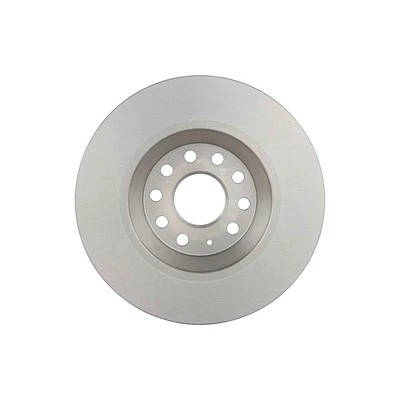
First, let’s get clear on what resurfacing a brake disc actually does. When brakes apply, the brake pad clamps down on the disc’s friction surface, creating friction that slows the vehicle. Over time, that surface gets worn: it develops tiny ridges, heat spots, and uneven wear that causes vibrations when you press the brake pedal. Resurfacing (also called turning or milling) is the process of removing a thin layer of metal from the friction surface to smooth it out, eliminate those ridges, and restore the flat, uniform contact between pad and disc. It’s not just a cosmetic fix—it’s a core service that keeps braking performance reliable.
Now, the key here is how much metal you can safely remove each time. Every brake disc is stamped with a minimum thickness specification, usually cast into the inner edge of the disc or listed in the manufacturer’s service manual. That number is non-negotiable—it’s the thinnest the disc can get without risking structural failure. Why? Because brake discs endure extreme heat, up to 1,500 degrees Fahrenheit during heavy braking. Too-thin discs can warp or crack under that heat, which is a major safety hazard. The maximum amount of metal you can remove in a single resurface is typically 0.5 millimeters (about 0.020 inches), but that’s just a baseline. The number of times you can resurface a disc boils down to the gap between its original factory thickness and that minimum safe thickness.
Let’s use a common example to make this concrete. A standard passenger car brake disc often has an original thickness of 28 millimeters (1.10 inches) and a minimum thickness of 24 millimeters (0.94 inches). That’s a 4-millimeter gap to work with. If each resurface removes 0.5 millimeters, you could safely resurface that disc 8 times—right? Well, almost. That’s where real-world conditions change the math. Every time you resurface a disc, you’re removing a layer of cast iron (the material most brake discs are made of, with some ceramic options for high-performance vehicles). Cast iron is durable, but each reshape wears away a tiny bit of its structural integrity, even if you’re staying within the thickness limit. That’s why even a disc with plenty of thickness left shouldn’t be resurfaced endlessly.
Real-world usage is the biggest factor here. A delivery van that does 100 stop-and-go trips a day will wear discs much faster than a sedan that only commutes 20 miles a day, and that changes how many resurfacing jobs it can handle. For heavy-duty vehicles like semi-trucks or buses, original disc thickness might be 40 millimeters, with a minimum of 35 millimeters. But because those vehicles carry heavy loads and brake far more often, mechanics often stick to a limit of 5 resurfacing jobs max, even with that 5-millimeter gap. Why? The repeated heat and stress of heavy-duty use wears down the disc far faster than a passenger car. For passenger vehicles that see mostly highway driving, you might get 6 to 7 resurfacing jobs out of a single disc—again, as long as you never go below the minimum thickness.
There’s also a catch with high-performance discs. If you’re working with a sports car or a heavy-duty truck with cross-drilled or slotted discs, resurfacing gets trickier. Those specialty designs have thinner base thicknesses to begin with, and the holes or slots cut into the surface mean you can’t remove as much metal without eroding those features. A slotted performance disc might only have a 2-millimeter gap between original and minimum thickness, so you’re looking at 3 to 4 resurfacing jobs max, not 8. Cross-drilled discs often have even lower limits because the holes can weaken the structure if you remove too much surrounding metal.
I’ve seen too many mechanics cut corners here: they resurface a disc because it has enough thickness, not because it actually needs it. That’s a mistake. Resurfacing a disc you don’t need to is just removing unnecessary metal, which shortens its lifespan and raises the risk of failure. We test our brake discs at our facility, and we’ve found that every additional resurface beyond the manufacturer’s recommended limit cuts the disc’s heat resistance by about 10 to 15 percent. A disc that works fine for daily commuting might warp during a steep mountain road drive if it’s been resurfaced too many times, because it can’t handle the same heat load as a new disc.
Another thing to consider is the quality of the resurfacing job itself. If the shop doing the resurfacing uses outdated equipment that doesn’t clamp the disc tightly to the lathe, you might get an uneven cut that creates warping. That means you might have to resurface a disc again sooner than you should, even if it’s only had one or two resurface jobs. We always advise our customers to go to a shop that uses a computerized lathe, because it ensures the cut is precise, removing exactly the right amount of metal across the entire surface. A bad resurfacing job is as bad as skipping resurfacing entirely, because it causes brake vibration, uneven pad wear, and even faster disc degradation.
Now, let’s talk about when you should stop resurfacing. First, if your disc is below the minimum thickness—even if it looks fine—you replace it. That’s non-negotiable. We see mechanics try to get an extra resurface out of a disc that’s just a hair over the minimum, and it rarely ends well. Last year, a fleet manager came to us with a semi-truck that had been resurfaced 6 times; when they measured it, it was 0.1 millimeters below the minimum. On a highway drive, the disc warped, the brakes locked up, and the truck crashed. No injuries, but $10,000 in damage—all because they tried to stretch a disc one resurface too far.
Another red flag: deep grooves, cracks, or heat spots (often called blue spots, where the metal has been overheated and turned blue). If your disc has any of those, resurfacing won’t fix it. The grooves are too deep to remove with a standard resurface, and cracks can spread when you apply brake pressure. Heat spots weaken the metal, so even if you resurface the disc, it will warp again in no time. We always tell mechanics to inspect for these damage signs before even thinking about resurfacing.
So, to sum up the practical number: for most passenger car brake discs, you can safely resurface 5 to 7 times. For heavy-duty vehicles, that number drops to 3 to 5. For high-performance or specialty discs, it’s 2 to 4. But that’s a general guideline, not a rule. The only hard, fast rule is the minimum thickness specification. If you stay above that, and you don’t see any damage that can’t be fixed with a resurface, you can go ahead. But if you’re approaching the 7th resurface on a passenger disc, it’s worth getting a new one—especially if the vehicle is used for heavy towing or frequent stop-and-go driving.
As a brake disc supplier, my job isn’t just to sell parts—it’s to help mechanics and fleet managers make smart, safe decisions. I’ve had customers who tried to stretch a disc to 9 resurface jobs, and every time it ended with a premature replacement. Others stick to the 5-resurface rule, and their discs last twice as long. It all comes down to balancing cost savings (resurfacing is cheaper than a new disc) with safety. If you’re resurfacing a disc that’s already had 6 jobs, you might save $50 now, but risk a $500 brake repair down the line, plus the safety of your driver.
If you’re not sure how many times a specific disc can be resurfaced, or you need a reliable supplier for new, high-quality brake discs, don’t guess. Reach out to our team to discuss your vehicle type, usage, and maintenance needs. We can help you navigate the resurfacing process, answer any questions about minimum thickness specs, and provide parts that meet all manufacturer safety standards.
Brake Disc References:
- Automotive Parts Manufacturers Association. (2022). Brake Disc Resurfacing Guidelines for Light and Heavy-Duty Vehicles.
- Society of Automotive Engineers (SAE International). (2021). Structural Integrity Requirements for Resurfaced Cast Iron Brake Discs.
- National Highway Traffic Safety Administration (NHTSA). (2020). Vehicle Brake System Component Failure: Analysis of Disc Thresholds.
- Brake Industry Manufacturers Association. (2023). Best Practices for Brake Disc Maintenance and Resurfacing.
Dongying Hongta Automobile Fitting Co., Ltd.
We’re known as one of the most professional brake disc manufacturers and suppliers in China, also support customized service. Please feel free to wholesale durable brake disc for sale here from our factory. For price consultation, contact us.
Address: No. 817 Bingsheng Road, Guangrao Economic Development Zone, Guangrao County, Dongying City, Shandong Province
E-mail: Amanda_song@hongtabrakes.com
WebSite: https://www.hongta-brake.com/
