If you’ve ever stood on the deck of a trawler returning from a week at sea, or a cargo vessel gliding past the coast with its lights blazing long after sunset, you’ve relied on a marine generator set – the unsung workhorse of every vessel that spends more than a few hours away from a dock or shore power connection. As a marine generator set supplier, I talk to skippers, chief engineers, and ship operators every week who take this piece of equipment for granted… until it sputters out mid-ocean. That’s when the panic sets in: no lights for navigation, no power for refrigerated cargo, no water heaters for the crew, no communications with the coast guard. So today, let’s break down how these systems actually work, no overly jargon-heavy textbook explanations, just the real-world stuff I’ve seen keep vessels running for 20 years. Marine Generator Set
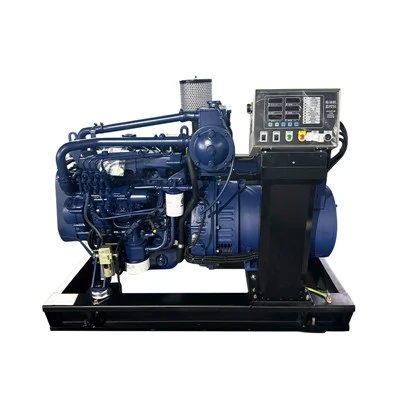
First, let’s get one thing straight: a marine generator set isn’t just a car engine bolted to a big battery. It’s a purpose-built system designed for the harsh, unpredictable conditions of the ocean – salt air, constant vibration, steep temperature swings, and not a mechanic within 100 nautical miles if something goes wrong. The core has two main parts, split almost like a team: the engine, which creates power by burning fuel, and the alternator, which turns that power into electricity you can actually use. Every part in between is there to make that connection safe, reliable, and compliant with maritime rules.
Let’s start with the engine, because that’s where the magic (or, more accurately, the controlled explosion) begins. Most marine gensets run on low-sulfur diesel, which is the standard for commercial vessels to cut down on air pollution and meet global emissions rules. Some older or smaller recreational models might run on gasoline, but those are rare for anything that needs consistent, high-output power – gasoline is too flammable for tight engine rooms and long voyages. Here’s how the engine works, step by step, inside the sealed, salt-resistant cylinder block: first, a precise amount of diesel is injected into a cylinder filled with compressed air. The compression heats the air so much that the diesel ignites on its own, no spark plug needed. That small explosion pushes a piston down in the cylinder, and that piston is connected to a crankshaft – a heavy, metal rod that turns that up-and-down motion into rotational torque.
Now, this isn’t just any crankshaft turning. Marine engine blocks are cast from thick, corrosion-resistant cast iron, and they’re mounted on shock-absorbing pads to stop the constant vibration from shaking the whole vessel apart. Even small 10 kW gensets for fishing boats have these pads; for 1,000 kW sets for container ships, the pads are so large they look like industrial dump truck tires. There’s also a cooling system built specifically for marine use, because overheating is one of the top causes of genset failure. Unlike car engines that use fresh water, most marine gensets run on a two-part cooling system: a closed loop of fresh water that circulates through the engine block to soak up heat, and a separate loop of seawater that cools that fresh water before it gets too hot. We always warn customers to check the seawater strainers every week – they get clogged with seaweed, barnacles, and trash, and when they do, the engine overheats and shuts down fast. I’ve seen a 50-meter cargo ship stuck 30 miles off the coast of Maine for 12 hours because a chief engineer forgot to clear a strainer during a routine check. That’s avoidable, but it’s one of the most common mistakes new operators make.
Once the crankshaft is spinning, it does two jobs: it powers the engine itself to keep the cycle going, and it powers the alternator, which is the part that turns mechanical energy into electrical energy. The alternator is mounted directly to the end of the crankshaft, so they spin at exactly the same speed – usually between 1,200 and 1,800 rotations per minute, depending on the size of the genset. Inside the alternator, there are two key components: a rotor (the spinning part connected to the crankshaft) and a stator (the stationary part wrapped in copper wire). The rotor has a small DC current running through it, which creates a magnetic field as it spins. As that magnetic field passes over the stator’s copper coils, it pushes electrons through the wire – that’s electricity, pure and simple.
But hold on, that electricity isn’t ready to power your vessel’s fridges, navigation systems, or crew quarters yet. First, it has to go through a control panel, which is the brain of the whole genset. I can’t stress how important the control panel is – it’s not just a switch to turn the genset on and off. Modern marine control panels monitor everything: engine temperature, oil pressure, fuel level, exhaust emissions, and the frequency and voltage of the electricity coming out of the alternator. If the voltage drops too low (say, if you turn on too many cranes on a cargo ship at the same time), the control panel will automatically adjust the engine’s speed to make more power, or even start a second genset if you’re running a parallel system for larger vessels. For smaller boats, the panel might be simpler, but it still has safety shutoffs that will turn the genset off if oil pressure drops too low – a critical feature, because running a marine engine without oil will seize it in minutes, and a seized genset on a small fishing boat can mean no power to the fishing nets or navigation lights.
Another key part most operators don’t think about is the exhaust system, which is built to handle both the engine’s fumes and marine conditions. Unlike car exhaust that just pops out a tailpipe, marine genset exhaust has to be routed out of the engine room, and it’s often wrapped in insulation to keep the engine room cool (hot engine rooms also lead to overheating). Many commercial gensets also have an exhaust gas aftertreatment system, which cleans the fumes to meet rules from the International Maritime Organization (IMO) that limit sulfur and nitrogen oxide emissions. This is a big reason why operators choose purpose-built marine gensets over old car engines – the aftertreatment systems and corrosion-resistant parts aren’t optional if you want to sail in international waters.
Now, let’s talk about how all this works in a real-life scenario, because that’s when you see why this system is so carefully designed. Take a 25-meter coastal cargo vessel that runs two gensets: one primary, one backup. When the ship leaves a port, the chief engineer starts the primary genset, follows the startup sequence on the control panel: checks oil pressure, waits for the cooling system to reach the right temperature, confirms the alternator is producing 480 volts (the standard for commercial vessels), and then connects the genset to the ship’s electrical grid. As the ship sails, the primary genset powers the navigation lights, the refrigerated hold that carries fresh fruit, the communications radio, and the crew’s cabins. If the genset’s load gets too high – say, when they activate the ballast pumps to adjust the ship’s draft – the control panel automatically adjusts the fuel injection to add more power, so the voltage stays steady and no systems shut off. If something does go wrong with the primary genset – maybe a clogged fuel filter – the control panel detects the drop in voltage and automatically starts the backup genset within 10 seconds, so no one on board even notices a blip in power. That’s the reliability operators count on.
As a supplier, I’ve seen a lot of common myths about marine gensets that I want to clear up, because they lead to bad choices that cause breakdowns. First myth: “A bigger genset is always better.” No, it’s better to have a genset sized exactly for your vessel’s power needs, plus 20-30% extra for peak loads. If you buy a genset that’s too big, it will run at low capacity most of the time, which causes more wear and tear and leads to more frequent repairs. If it’s too small, you’ll never have enough power when you need it. Second myth: “You don’t need to maintain it until it breaks.” Marine gensets have a 5,000-hour maintenance schedule: change the oil, replace fuel filters, check the seawater strainers, test the alternator’s connections. We’ve had customers skip maintenance and end up replacing a whole engine for $50,000 when a $50 oil change would have prevented it. Third myth: “All gensets are the same.” A genset built for a 10-day transatlantic voyage has different corrosion-resistant parts, better cooling, and a stronger control panel than a genset built for a small recreational boat that only goes out for a weekend. Trying to save money by buying the smaller, cheaper model for a commercial vessel is a risk we see too often.
Another thing that sets marine gensets apart from land-based generators is their adaptability. Many modern systems come with parallel capability, meaning you can connect two or more gensets together to power larger loads, like when a container ship is loading 100 cranes at a port. Some also have shore power connection, so when a vessel is docked, you can plug into shore power instead of running the genset, saving fuel and reducing emissions. For recreational boaters, that means you don’t have to run the genset all weekend to power your air conditioner and refrigerator – you can plug into the marina’s power and save on fuel and maintenance.
The last piece of the puzzle, and the most important for operators, is reliability. When you’re 200 miles from shore, the last thing you want to do is troubleshoot a genset. That’s why all the parts – the engine, alternator, control panel, cooling system – are built to withstand the ocean’s toughest conditions. The copper coils in the stator are sealed to prevent salt damage, the engine block is coated to resist rust, and the control panel has waterproof connections so spray and rain don’t cause shorts. We test every genset we sell for 24 hours straight under full load, before it even leaves our warehouse, to make sure it runs smooth and steady, no matter the conditions.

If you’re a skipper, chief engineer, or vessel operator, you know how critical a reliable marine generator set is to your business or your voyage. Whether you’re running a small fishing boat, a cargo vessel, a yacht, or an offshore support ship, choosing the right genset isn’t just about buying a piece of equipment – it’s about having peace of mind when you’re out on the water, knowing your power will be there when you need it. If you’re looking to upgrade your current genset, replace an old one, or ask questions about sizing, maintenance, or compliance with maritime rules, we’re here to help. We work with operators of all sizes, from small family fishing boats to large commercial fleets, to find the right solution for your needs. Don’t wait until your genset fails mid-voyage – reach out to discuss how we can support your marine power needs today.
Diesel Engine References
U.S. Coast Guard Marine Engineering Regulations, 2023
International Maritime Organization (IMO) Emission Standards for Marine Engines, 2022
Diesel Engine Technology for Marine Applications, SAE International, 2021
Marine Generator Set Maintenance Guide, National Marine Manufacturers Association (NMMA), 2020
China Modo Investment Co., Ltd.
As one of the most professional marine generator set manufacturers and suppliers in China, our products have good reputation in the market. We warmly welcome you to wholesale advanced marine generator set in stock here from our factory. If you have any enquiry about cooperation, please feel free to email us.
Address: Boye Industrial Park,Baoding city,Hebei Province,China.
E-mail: sales@mstengine.com
WebSite: https://www.mst-engine.com/
