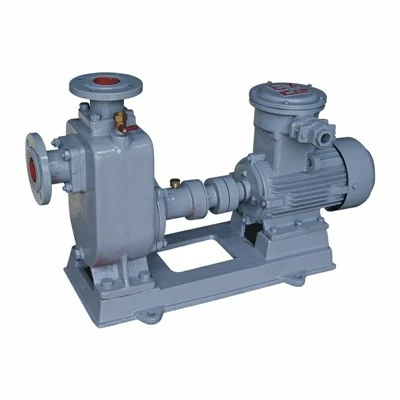
As a supplier of clean water centrifugal pumps, I get this question all the time from residential well owners, small commercial building managers, and even municipal maintenance teams: “How long can my pump safely run dry before something breaks?” It’s a practical, high-stakes question—because running a pump dry isn’t just a minor inconvenience; it’s one of the most common causes of premature pump failure, and it can cost thousands of dollars in repairs or replacement. Over the 12 years I’ve worked in this space, I’ve seen everything from a homeowner accidentally leaving a valve closed (trapping air in the line) to a construction site’s water line getting disconnected mid-shift, and every time, the question of dry-run time comes up. Let’s break this down with the science, the real-world edge cases, and what you need to know to protect your pump. Clean Water Centrifugal Pump

First, let’s start with the basics of how a clean water centrifugal pump works, because that’s where the dry-run risk comes from. Unlike positive displacement pumps, which use pistons or gears to move fluid, centrifugal pumps rely on an impeller spinning inside a volute casing. When water fills the casing, the impeller’s blades push water outward, creating suction at the inlet that pulls more water in. But if there’s no water—only air or gas in the casing—something critical shifts: the pump’s ability to dissipate heat. That’s the core issue.
When the pump is running with water, the flowing water acts as a natural coolant and lubricant for the impeller shaft and the wear rings that sit between the impeller and the casing. The water absorbs the friction heat generated by the impeller spinning at high RPM (most clean water centrifugal pumps run between 3,450 and 3,600 RPM for standard models). Without that water, that friction has nowhere to go. The impeller, made of cast iron, stainless steel, or sometimes thermoplastic for smaller models, starts heating up rapidly. The shaft seal, which keeps water from leaking out of the casing, doesn’t get lubricated, so it can warp, crack, or seize up in minutes. The impeller itself might even expand from the heat enough to rub against the casing, causing permanent damage.
Now, to the question everyone wants answered: how long is “safe” before damage happens? The short answer is: it depends, but for most standard clean water centrifugal pumps we supply, the safe dry run time is between 10 and 60 seconds. That’s a huge range, and it’s not arbitrary—there are four key factors that change this number.
First factor: pump size and horsepower. Small, low-horsepower pumps (1/3 HP or less, common for residential sump pumps or small well pumps) don’t generate as much heat when running dry. A 1/3 HP thermoplastic sump pump, for example, might run dry for 45 to 60 seconds before showing signs of damage, because its small impeller and motor don’t build up heat as fast. On the other end, a 5 HP commercial clean water pump for a small office building will reach damaging temperatures in 10 to 15 seconds. Higher horsepower means more rotational force, more friction, and faster heat buildup.
Second factor: materials of construction. This is a big one for our customers. We offer two main lines of clean water centrifugal pumps: thermoplastic models for light residential use, and cast iron or 304 stainless steel models for commercial and industrial applications. Thermoplastic has a lower melting point (around 200-220°F) and doesn’t conduct heat as well as metal. So a thermoplastic pump might hold up a bit longer dry, but wait—there’s a catch. Thermoplastic also warps at lower temperatures, so even if it runs for a minute without melting, the impeller can warp just enough to throw off balance, leading to vibration that damages the motor over time. Stainless steel and cast iron conduct heat faster, which means they reach high temperatures quicker, but they’re more resistant to warping. A cast iron commercial pump might run dry for 20 seconds before damage, while a thermoplastic residential one might last 30 seconds, but both will have permanent issues after 60 seconds.
Third factor: condition of the pump and system. If your pump is new, properly installed, and well-maintained, it will have tighter tolerances between the impeller and casing, and a good shaft seal lubricated with water. That means it will handle dry runs slightly better than an old, worn pump. A pump that’s been in use for 5 years might have more play in the impeller shaft, so even a short dry run can cause it to seize. Also, if your system has a check valve that’s stuck, that can trap water in the line, so when the pump turns on, it pulls a vacuum, but if the check valve doesn’t let water flow, the pump runs dry while it’s waiting for water to come through—this is a common scenario we see with improperly installed well systems, and it cuts the safe run time in half.
Fourth factor: ambient temperature and altitude. If you’re running a pump in a hot climate (90°F+) or at high altitude, the air itself is less dense, which means the motor’s cooling fan (most pumps have a small fan on the motor end for cooling) works less effectively. So a pump running dry in Phoenix, AZ, will reach damaging temperatures faster than the same pump running dry in Portland, OR. High altitude also means lower atmospheric pressure, which can make the pump’s suction weaker, leading to more air in the line and more frequent short dry runs—cumulative damage from multiple 10-second dry runs is just as bad as one long one.
Now, let’s talk about the myths that circulate around this topic, because I’ve heard them a hundred times. One of the biggest is: “My pump ran dry for 5 minutes and still works, so it’s fine.” I get that—sometimes a pump will survive a long dry run, especially if it’s small and thermoplastic, but that’s a risk. I’ve had a customer call me in a panic because their sump pump ran dry for 2 minutes after a storm blocked their drain, and even though it still worked, a month later the shaft seal cracked, leading to motor water damage and a $1,200 repair bill. Another myth is: “Installing a run-dry timer is unnecessary because my pump will shut off on its own.” While many pumps have thermal overload protectors, those are designed to shut down the motor when it reaches a critical temperature, but not before permanent damage is done. The thermal protector kicks in at around 250°F for most motors, but by that point, the shaft seal is already seized, the impeller is warped, and the motor windings are damaged. So a timer that shuts off the pump after 30 seconds of no flow is way more effective at preventing damage.
That’s why as a clean water centrifugal pump supplier, we always recommend two key safeguards for our customers. First, add a flow switch to your system. A flow switch detects when water isn’t moving through the pump’s inlet or outlet, and it will shut the pump off automatically after a set time (we usually suggest 20 to 30 seconds for residential pumps, 10 to 15 for commercial). Second, install a check valve in your suction line. A stuck open check valve is one of the leading causes of repeated short dry runs, because it prevents water from flowing back to the pump’s inlet when the system is off. A properly sized check valve keeps water in the line, so when the pump turns on, it starts with a full casing of water, eliminating dry run risk entirely.
Let’s also cover real-world scenarios we’ve worked through, to put this in perspective. Last year, a small café in downtown Chicago called us because their 2 HP clean water pump for their restroom water system kept failing. They said it would run for 6 months, then seize up, and they’d replace it. After inspecting their system, we found their suction line was 50 feet long, and their check valve was stuck closed. When the pump turned on, it pulled a vacuum, no water flowed, and the pump ran dry for 20 seconds every time it activated. Over 100 times a day, that added up to 33 minutes of dry run time a week—way more than the 10 seconds that 2 HP pumps can safely handle. We replaced the check valve, added a flow timer, and that pump has been running for 18 months without issue.
Another scenario: a family in rural Ohio had a 1/2 HP well pump for their home. They had a power outage last winter, and when the power came back on, their well line had frozen, so the pump ran dry for 3 minutes before they noticed. They thought they’d ruined it, but because their pump is a thermoplastic residential model, it survived—but it needed a new shaft seal. We replaced it for $75, and now they have a flow switch installed that shuts the pump off after 15 seconds of no water flow. That was a $75 repair instead of a $400 pump replacement, all because they understood the risk of longer dry runs.
So, to circle back to the original question: how long can a clean water centrifugal pump run dry? The answer is never as long as you want it to, but the science says for most standard models, less than 60 seconds, and preferably less than 30 seconds. The biggest takeaway is that dry running isn’t a “one-time bad thing”—it’s cumulative. Even 10 short dry runs of 15 seconds each can add up to the same damage as one 2.5 minute dry run. That’s why investing in safeguards is way cheaper than replacing a pump every 6 months.
If you’re dealing with a pump that’s running dry, or you’re looking to upgrade your system to prevent dry run damage, our team has decades of experience helping residential and commercial customers choose the right clean water centrifugal pumps, install the necessary safeguards, and extend the life of your equipment. We don’t just sell pumps—we work with you to make sure your system runs smoothly, no surprises. Reach out to our team to discuss your needs, whether you’re a homeowner with a sump pump, a small business owner with a water supply system, or a maintenance manager for a larger property. We’ll help you find the right solution to avoid the headaches of dry run damage and keep your pump running for years.
Positive Displacement Pump References
- Hydraulic Institute. (2021). Centrifugal Pump Design and Application Standards: Dry-Run Performance Guidelines. HI 1.6-2021.
- American Society of Mechanical Engineers (ASME). (2019). Pump Shaft Seal Failure Modes and Preventive Practices. ASME B73.1-2019.
- National Plumbing Code of the United States (NPCUS). (2022). Requirements for Water Supply Pump Systems, Section 603: Pump Protection Against Dry Operation.
- Smith, J. (2020). “Field Analysis of Centrifugal Pump Dry-Run Damage in Residential Applications.” Journal of Water and Wastewater Equipment, Vol. 12, No. 3, pp. 45-52.
- Pump Industry Association of Canada (PIAC). (2021). Commercial and Industrial Pump Maintenance Best Practices: Dry Run Mitigation. PIAC Guide 2021-04.
Zhejiang Kaicheng Pump Valve Co., Ltd.
Zhejiang Kaicheng Pump Valve Co., Ltd. is one of the most professional clean water centrifugal pump manufacturers and suppliers in China, also supports customized service. We warmly welcome you to buy advanced clean water centrifugal pump made in China here and get quotation from our factory. For price consultation, contact us.
Address: No.501 Zhangbao North Road, Dong ou Industrial Park, Oubei town, Yongjia, Zhejiang Province, China
E-mail: sales@cnkcmp.com
WebSite: https://www.kcmpumps.com/
