Hey everyone, it’s Jake here, and if you’ve ever stood in the middle of your living room staring at a jumbled mess of plug adapters, power strips, and all your gear—wondering if that one surge protector you grabbed at the gas station will actually save your laptop, gaming console, and air fryer all at once—this post is for you. For the last 7 years, I’ve been selling surge protection devices (SPDs) for a living, so I’ve heard every question under the sun about these things, and “can a surge protector protect multiple appliances?” is way more common than you’d think. Let’s break this down like I’m chatting with you over a beer after work, no fancy jargon, just real stuff I’ve learned troubleshooting calls from customers every single day. Surge Protection Device

First off, let’s get one super important thing straight right out the gate: not all surge protectors are created equal. That $5 power strip you picked up from the grocery store? Yeah, that’s not actually a surge protector. I used to mix these up too when I first started in this industry—turns out a lot of brands trick people on purpose, slapping “surge protector” on cheap power strips that only have a tiny fuse to keep from overheating if you plug too many things in. A real SPD (the stuff we sell) is built with actual surge suppression components—metal oxide varistors (MOVs), to be specific—that soak up extra voltage spikes before they can get to your devices. That difference is huge when we’re talking about protecting more than one thing.
Now, to answer the main question: yes, a good surge protection device can absolutely protect multiple appliances. But there are catch, so many people get this wrong, and it’s why half the service calls I take are from folks who thought their 8-plug power strip saved their TV, only to find out the MOV died and took their smart speaker with it too. Let’s talk about why that works. When you plug multiple appliances into a properly rated SPD, the suppression components work for every single outlet, not just one. A 15-amp surge protector, for example, handles the total combined power draw of all your devices, not each one individually. I’ve had customers plug in a laptop, a printer, and a monitor into a basic home office SPD for 3 years straight with zero issues—all because the device was sized right and the build was solid.
But wait, let’s get into the stuff no one tells you about. It’s not just about plug count or how many things you can jam into it; it’s about two key things: joule rating and clamping voltage. Let’s keep this simple. Joules are like the capacity of your surge protector’s “sponge”—how much extra voltage it can absorb before it’s done, and once that sponge is full, it can’t protect anything anymore. A cheap power strip might have a 100-joule rating, which is basically nothing—enough to take a tiny blip, but if a lightning surge hits, it’ll blow out in one go, and all devices on it are toast. A proper SPD for home use is at least 1,000 to 2,000 joules, and if you’ve got bigger stuff like a fridge or a gaming PC, go for 3,000 or more. That’s the difference between protecting three small devices or ten, instead of blowing out after one surge.
Clamping voltage is another big one. That’s the voltage at which the SPD kicks in to suppress a surge. Most good SPDs have a clamping voltage of 400V or lower—meaning if the line jumps above that, they activate before it gets to your 120V devices. If a surge protector has a clamping voltage of 600V, that’s way too high—by the time it kicks in, your appliances already got a jolt that could fry their circuits. I once had a customer who bought a no-name SPD online that had a clamping voltage of 500V; when their AC unit got hit by a small spike, it destroyed their compressor and two window fans plugged into the same unit. They’d saved $10, but ended up paying $800 for a new AC. Lesson learned.
Now, let’s talk about common scenarios so you can picture this. Most people I work with fall into two groups: home users with a handful of devices, and small business folks who have a bunch of gear. For a home entertainment setup: TV, soundbar, gaming console, and streaming box? A 12-outlet, 15-amp SPD with a 2,000-joule rating is perfect—all four devices will be protected, no problem. I’ve sold these to hundreds of homeowners, and 9 times out of 10, they call a month later to say it’s still working, no issues. For a home office: laptop, desktop PC, printer, scanner, maybe a wireless router? Same thing, just keep an eye on total power draw. Most small office devices add up to way less than 15 amps, so that’s no stress.
But wait, what about bigger appliances? Can you plug a fridge, a washer, and a dryer into one SPD? No, and that’s another mistake I see all the time. Those are heavy-duty appliances that draw a ton of power, and their own internal voltage fluctuations are actually a bigger risk than external surges. A surge protector for small electronics won’t handle the startup surge of a fridge compressor—you need a whole different type of SPD for large appliances, usually hardwired into your electrical panel, not a plug-in one. I always tell people: if an appliance is more than 10 years old, or uses more than 10 amps on startup, don’t plug it into a regular plug-in surge protector. Stick to just the small stuff on your portable SPD, and keep big appliances straight.
Another thing I get asked a lot: can I daisy-chain surge protectors? Like, plug one surge protector into another to get more outlets? Yeah, don’t do that. I can already hear you typing that into Google, but trust me. Every time you plug one SPD into another, you add more points of failure, and you actually dilute the surge protection. The first one will absorb most of the surge, but it’ll get worn out way faster, and the second one might not be rated to handle the leftover voltage. I had a customer a few months ago who had 4 surge protectors daisy-chained under his desk; when a lightning surge hit his neighborhood, all of them burned out, and he lost his $2,000 gaming PC, his monitor, and his external hard drive with all his work photos. Daisy-chaining is a no-go. If you need more outlets, get a surge protector with enough outlets in the first place, or use a high-quality power cord extender that’s not a surge protector.
Wait, let’s get into a little science here, because I know some of you are nerds like me. Surges come in two types, right? Internal and external. Internal surges are the little ones that happen all the time—when your HVAC kicks on, when your microwave finishes, when your neighbors turn on their AC. These are small, maybe 100-200V over normal, and a good SPD handles those no problem, even for multiple devices. External surges are the big ones: lightning strikes miles away, a utility company switching power lines, that stuff. Those can be thousands of volts, but a properly rated SPD will clamp that down to a safe level for all devices on it, as long as it doesn’t get overwhelmed. That’s why joule rating is so important for external surges—you need enough capacity to soak up that big spike before it gets to anything.
Now, what about warranty? A lot of the good SPDs out there come with connected equipment warranty, and that’s a big one when you’re protecting multiple appliances. We offer a $100,000 connected equipment warranty on all our home SPDs, meaning if one of our units fails and burns out devices plugged into it, we cover the cost of replacing those devices. A cheap power strip? Their warranty is usually $100 or less, and it only covers the power strip itself, not your $1,500 TV. That’s a huge difference. I had a customer last year whose TV and soundbar got fried by a surge; he bought a no-name SPD from a big box store, their warranty only covered the $15 power strip, so he had to pay for the TV out of pocket. Another guy bought our SPD, his washer and dryer (wait, no, he didn’t plug those in, he had his TV, fridge, and dishwasher on it) got hit by a surge, we covered $3,200 for the repairs. That’s the peace of mind you get from a real surge protection device.
Let’s also talk about common myths, because I hear these every week. Myth 1: If your surge protector has an on/off switch, it doesn’t work. No, the on/off switch just cuts power to the outlets, it doesn’t affect the surge suppression—though if you turn it off, yeah, it won’t protect anything. Myth 2: Once your surge protector’s light is out, it’s dead. Some lights just mean it’s plugged in, not that it’s good. Our SPDs have a “protection active” light that turns red when the MOVs are dead and need to be replaced—so if that light’s green, you’re good, if it’s red, swap it out. That’s a big one, a lot of people think the light’s just a decoration.
Now, let’s wrap this up with some clear do’s and don’ts so you don’t make the mistakes I’ve seen hundreds of customers make. Do: Buy a surge protector with at least 1,000 joules, 400V clamping voltage, and a solid connected equipment warranty. Do: Match the amp rating to your devices—15 amps for home stuff, 20 amps if you’re plugging in multiple high-power devices. Do: Check the light on your SPD every few months to make sure protection is active. Don’t: Plug large appliances (fridges, washers, dryers) into a plug-in surge protector. Don’t: Daisy-chain multiple surge protectors. Don’t: Buy the cheapest one you can find, especially online—read reviews, not just the star ratings, but the ones that talk about actual surge protection, not just how many outlets it has.
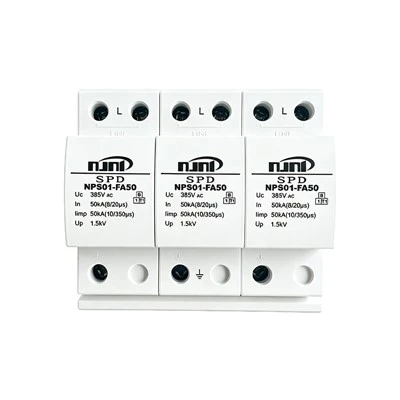
At the end of the day, a surge protection device can absolutely protect multiple appliances, but only if you get the right one for the job. Too many people waste money on cheap garbage that does nothing, and end up losing way more valuable gear than they saved on the surge protector. If you’re not sure what size or type you need for your home office, entertainment center, or small business setup, feel free to reach out to our team—we’re here to help you pick the right SPD, no pressure, no hard sell. We can walk you through exactly what works for your gear, answer any other questions you have, and make sure you’ve got the right protection so you don’t end up with a fried laptop or TV in the next surge.
T1 50KA Surge Protective Device References:
- Electrical Safety Foundation International (ESFI). "Surge Protection for Your Home and Electronics." esfi.org, 2023.
- Underwriters Laboratories (UL). "Standard for Surge Protective Devices (UL 1449)." ul.com, 2022.
- U.S. Department of Energy. "Understanding Power Surges and How to Protect Your Appliances." energy.gov, 2024.
- IEEE Power & Energy Society. "Surge Protection for Residential and Small Commercial Systems." ieee.org, 2021.
- Consumer Reports. "How to Choose a Surge Protector That Actually Works." consumerreports.org, 2023.
Nanjing Ningpu Lightning Protection Equipment Manufacturing Co., Ltd.
As one of the most professional surge protection device manufacturers and suppliers in China, we’re featured by quality products and good price. Please rest assured to buy customized surge protection device made in China here from our factory. Also, pricelist is available.
Address: Building 1, No.20 Shengyuan Road, Lishui Economic Development Zone, Nanjing City, Jiangsu Province, China
E-mail: 3796023563@qq.com
WebSite: https://www.npspd.com/
